
The first words you speak decide much of the interview. A newcomer who wants a first job, a seasoned worker who changes field or a parent who returns after years at home all hear the same request: “Tell me about yourself.”
Many people think too hard. Some stop talking. Some talk without end. Some repeat facts that already appear on the résumé.
This guide shows a clear method for the opening sentence, points out the usual mistakes, lists what the interviewer wants to hear and gives proven examples. Picture a colleague seated beside you who states each step in plain terms.
Table of Contents
Why Self-Introduction Matters So Much

A self introduction in interview is not just a formality. Interviewers look at it as:
- A quick way to know the person
- A way to check confidence
- A way to check communication
- A peek into the candidate’s personality
- A hint of whether they’ll fit in
Even before the interviewer checks skills, this introduction sets the mood. If the candidate starts strong, the rest becomes smoother.
What Interviewers Expect in a Self Introduction
Interviewers don’t want long speeches. They want clarity.
Here’s what they expect in an interview self introduction:
- Who the person is (name + short background)
- What they do (education or current role)
- What they’ve done (skills, achievements, strengths)
- What they want next (why this job or company)
If someone nails these four points, the interviewers feel the person is professional, confident, and sorted.
How to Start Self Introduction in Interview: The Clean Format

Most candidates go blank because they don’t know where to start. The trick is simple — follow a clean structure.
Here’s an easy self introduction format:
- Greeting
- Name
- Place or background
- Education / Work experience
- Skills
- Achievement or highlight
- Reason for applying
- Closing line
This structure works for freshers, experienced candidates, and career-switchers too.
Interview Self Introduction Example for Freshers
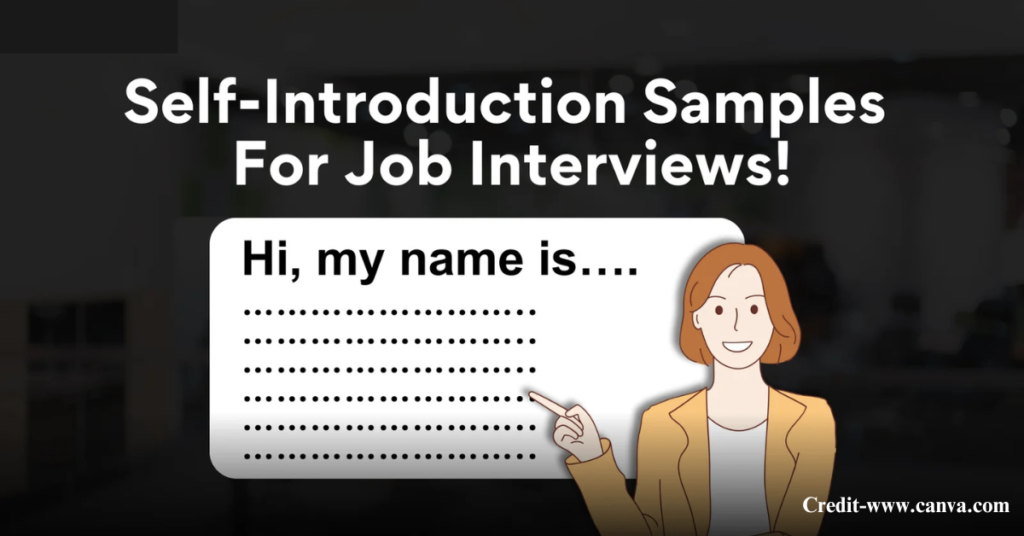
Here’s a version for someone with work experience:
“Good afternoon Ma’am. I’m Anushka sharma, and I’ve spent the last three years worked as a customer service associate at TechSupport Global. I handled calls, solved user problems, and trained new team members. Last year, I got the ‘Top Performer’ award for maintaining the best call resolution score. I’m applying for this role because I want to take on more responsibility and work in a company known for great customer experience.”
Short. Simple. Honest.
Self Introduction for Career Switchers
Many people feel fear when they change careers. The method stays the same – talk only about skills that move with you.
Example
“Good morning, Sir. My name is Aman Verma. For two years I sold products – during that period I learned how to speak with clients and how to serve them. Later I became curious about digital marketing. I passed three certificate courses plus completed small paid tasks on my own. I want this post because it lets me keep my old strengths and learn a new discipline.”
What NOT to Say in Your Self Introduction

A strong introduction avoids:
- Life stories
- Family details
- School marks
- Negative experiences
- Jokes that don’t land
- Repeating the resume word-for-word
Candidates should keep things clean and to the point.
Self Introduction Tips for Interview
Keep it short
1 minute is perfect. Anything longer feels dragged.
Speak naturally
Interviewers don’t expect perfect English — just clarity.
Use simple words
No need to sound complicated or fancy.
Maintain eye contact
Just enough to look confident.
Add one highlight
A project, achievement, or skill that makes the person stand out.
Match the intro with the job role
Keep it relevant.
Common Mistakes Candidates Make

Here are the problems most candidates face during interview introduction:
- Speaking too fast
- Sounding like they memorized a script
- Sharing too much background
- Talking about weaknesses
- Starting with “Myself…” instead of “I am…”
- Freezing due to nerves
With a little practice, anyone can avoid these mistakes.
Advanced Self Introduction Tips (Many Competitors Miss These)

Most competitor sites cover basics only. But here are extra details that help someone stand out:
Share a micro-story
A tiny story makes the candidate more human.
Example:
“I got into coding after I built my first website in college…”
Show what the person cares about
Interviewers like purpose.
Example:
“I enjoy solving customer problems — it’s something I genuinely like.”
Connect past experience to the job
Shows clarity.
Assume the interviewer already saw your resume
So no need to repeat basics.
Use an elevator-pitch style introduction
Short, sharp, clear.
How to Close Your Self Introduction Smoothly
Most people stop awkwardly. Here’s a smooth ending:
“That’s a short summary of my background. I’d love to share more about my experience as we move forward.”
This gives confidence and invites the next question.
Strong Self Introduction Lines You Can Use
Here are some powerful but simple interview intro lines:
- “To share a quick summary about me…”
- “To begin with, my name is…”
- “I’ll keep my introduction short and clear…”
- “Here’s a quick look at my background…”
These work well in both virtual and in-person interviews.
Self Introduction in English: Short Versions You Can Try
If someone wants super short lines:
Version 1
“I’m a commerce graduate with an interest in accounting and finance. I completed two internships and worked on GST filing tasks.”
Version 2
“I’m a technical support associate with two years of experience helping customers solve device issues.”
Version 3
“I’m a fresher with skills in Canva, content writing, and social media.”
Mini Templates for Self Introduction
Template 1: Freshers
“My name is ___. I completed my ___ in ___. I’ve worked on projects like ___. My main skills are ___. I’m applying because ___.”
Template 2: Experienced
“I’m ___. I’ve worked for ___ years in ___. My main tasks were ___. I achieved ___. I’m applying because ___.”
Template 3: Switchers
“I’m ___. I spent ___ years in ___. I’ve developed skills like ___. Recently, I’ve been learning ___. I’m applying because ___.”
Why a Good Introduction Improves Interview Confidence
People think confidence comes before speaking. But often, speaking clearly builds confidence.
Once someone starts well, the rest of the interview feels smooth. A good introduction also helps the interviewer ask better questions.
FAQs
How long should my self-introduction be?
Around 45–60 seconds.
Should I mention family details?
No. It’s not needed unless the interviewer asks.
Is it okay to memorise?
It’s fine to practice. Just don’t sound robotic.
Should I mention weaknesses?
Not in the introduction.
May I mix Hindi with English?
You may. The mixture is acceptable when the main point stays plain.
Do I state my hobbies?
State them only when the interviewer asks or when they fit without strain.
Is the introduction the same for virtual interviews?
Yes, but keep your posture and voice clear.
Final Thoughts
A self-introduction for an interview needs no ornate phrases – it needs only clear facts, plain words and an even order. When the applicant states name, past work plus next goal in that order, the words stay in the listener’s mind. Interviewers recall the voice that tells the truth – they forget the voice that repeats a polished script.
Each introduction carries a personal tone. The only rule is to keep the tone honest, the posture certain and the speech human.